Implementing Anton’s Law in Maryland

Miranda Spivack and Rebecca Snyder

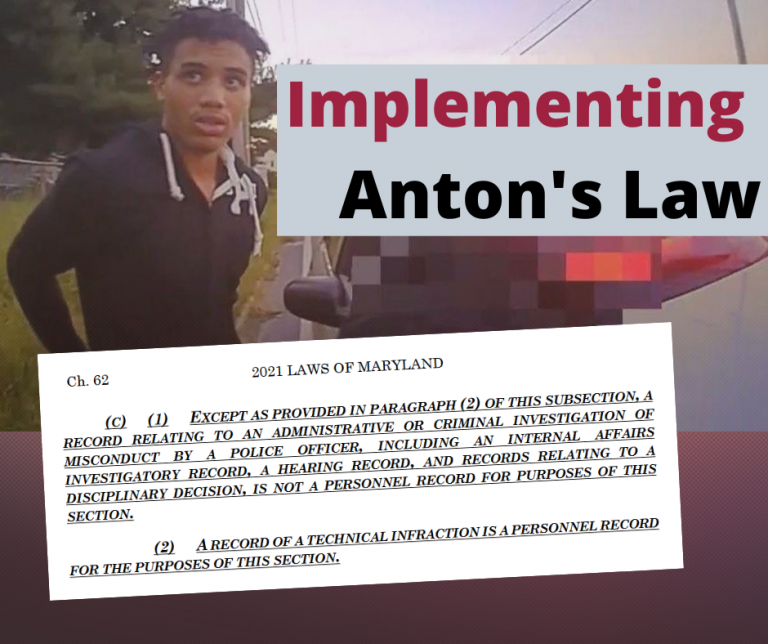
A person stands outdoors next to a vehicle overlayed with the text

A community group in Montgomery County was asked to pay $95,000 for copies of police discipline and complaint records, which, under a 2021 change in Maryland law, are no longer automatically private.


Local public defenders in Baltimore seeking those records have been told to pay as little as $10 to the Harford County Sheriff’s Office but as much as $224,000 to the Calvert County Sheriff’s Office and nearly $500,000 to the Montgomery County Police Department.


Reporters in Washington and Baltimore and student journalists at the University of Maryland say they have received some internal police discipline records they’ve requested, but also have encountered long delays and huge fees.


Anton’s Law, formally known as the Maryland Police Accountability Act of 2021, went into effect on Oct. 1, 2021. The measure makes internal police discipline and complaint records available to the public, erasing an exemption that had placed them off limits under the Maryland Public Information Act. Until Anton’s Law was enacted, members of the public could not find out if police officers in Maryland had been disciplined for misconduct or were the subject of numerous complaints reviewed by internal police investigators.


But five months since taking effect, Anton’s Law has not yet lived up to its promise.

Anton’s Law is named for Anton Black, a 19-year-old Black man from Greensboro in Caroline County, Md., who died in 2018 in police custody, after he was wrestled to the ground by three white officers and a white civilian bearing a Confederate emblem. While Black was struggling to breathe, his mother was standing nearby, witnessing the encounter and shouting his name.

Black’s death, several other deaths in police custody in Maryland, and the death of George Floyd in Minneapolis in 2020 in police custody helped spur Maryland lawmakers last year to take steps to open up information about police conduct, discipline, complaints and work history.


While some Maryland law enforcement agencies are now providing, upon request, documents that Anton’s Law says are now public records, many departments are struggling to comply with the law. Advocates for police transparency, defense lawyers and journalists say their requests for documents and data have been met with a wide range of responses — and many have not even been acknowledged.


“We would certainly argue that the legislature has determined that these records are in the public interest,” said Deborah Jeon, the legal director of the Maryland branch of the American Civil Liberties Union, which often relies on obtaining law enforcement and other government records without incurring high fees. And the legislature’s intent with Anton’s Law, she said, was minimal fees and expansive public disclosure by Maryland law enforcement agencies.

Anton’s Law works in tandem with the Maryland Public Information Act, which requires state and local governments to provide broad access to their records.


The MPIA, as it is commonly called, also gives requesters the right to ask for data and documents for free, or minimal cost, if they can show that public disclosure serves the public interest.


But the state’s largest police departments say they need more funds and more staffing to comply with new requirements under Anton’s Law. The upshot is that some law enforcement agencies in Maryland say they are being compelled to produce reams of documents, videos and audios without new employees or money to pay for the thousands of hours of work they say it takes.


In Montgomery County, Assistant Police Chief Darren Francke said the police department has about 1,500 internal investigative files that could be eligible for disclosure under Anton’s Law. Each contains between 200 and 5,000 pieces of paper, he said, and many also have video and audio. All must be reviewed to ensure that private information and other data that the MPIA says can be withheld are not inadvertently disclosed.


Little, if any of the paper, is digitized, though the Montgomery department is beginning to scan documents and create digital files, which eventually will make it easier to review and release the material. The department has asked County Executive Marc Elrich, a Democrat, to include more money for Anton’s Law in his budget proposal, which will be released on March 15 but must then win approval from the County Council. Elrich’s budget proposal includes about $427,000 for additional staffing — some civilians and some sworn officers — to improve compliance with Anton’s Law, according to Scott Peterson, a spokesman for Elrich.

“We are working very hard. We have many people assigned to work on this,” Francke said. “It is not our intent not to answer requests.”


The Baltimore Police Department and the Prince George’s County Police Department are reporting similar issues.


In Baltimore, police spokeswoman Lindsey Eldridge wrote in an email that the department is “staffing up … to better fulfill all MPIA requests.” But because of the high volume of requests, she wrote, the department plans to contract with an outside firm that will provide contract lawyers to help review the material. “This will come at a cost, either to the department or the requestor, which is determined on a case-by-case basis as provided by state law. BPD intends to fulfill these requests and does not intend to redact officer names. While we’re experiencing some logistical challenges getting this operation off the ground, that should not be misinterpreted as resistance or lack of transparency.”


In Prince George’s, where advocates and journalists say the process has been particularly slow, Gina Ford, a spokeswoman for County Executive Angela Alsobrooks, a Democrat, wrote in an email that the “county is working diligently to meet these mandates.”


But she predicted “a greater strain on county resources.” The email said the county plans to continue to charge fees for record requests if they require more than two hours to fulfill, as the Public Information Act allows.


Elena Russo, a spokeswoman for Maryland State Police, wrote in an email that the agency had received 26 requests for personnel records under Anton’s Law since the law took effect.

Police provided information in 17 cases (other requests were pending or withdrawn, or there were no matching records). Of the 17, police did not charge for records in 14 cases and had minimal charges in two. In the remaining case, there was an $1,822 charge for an extensive request, Russo wrote.


The push for greater transparency


When the General Assembly approved Anton’s Law in 2021 — sponsored by state Sen. Jill P. Carter (D-Baltimore) and Del. Gabriel Acevero (D-Montgomery) — Maryland joined several other states, including California, Colorado, Massachusetts and New York, in opening up internal police discipline and complaint records. Most have pushed ahead with the disclosure laws despite considerable resistance from police unions, and in some cases, police chiefs.

However, some chiefs who manage law enforcement agencies around the country have said they would welcome more transparency, because they, too, are often prevented from getting access to officers’ internal personnel records, a limit frequently written in to state and local government contracts negotiated with police unions.


In Maryland, Anton’s Law took effect after legislators overrode Republican Gov. Larry Hogan’s veto of the bill and several other bills requiring more public accountability from law enforcement.


But the General Assembly may not have fully accounted for how police agencies would react to Anton’s Law. The legislators did not include additional funding or apply pressure to local governments to fund the law, which may partly explain the resistance to disclosure and the high fees to locate, review and provide the documents. (An MDDC review in 2019 found that Maryland police agencies traditionally charge much higher fees for records than other government entities do.)


On March 15, a bill Carter proposed to place limits on fees that law enforcement charges for police misconduct records will be the subject of a legislative hearing.

Carter wrote in an email that it’s hard to measure the impact of Anton’s Law based on several months.


“What we do know, however, is that some jurisdictions have forestalled specific components from being enacted. For example, some police departments charge astronomical fees to obtain public information, and some have outright refused its release,” she wrote. She expects her bill limiting fees to help.


“I unquestionably believe that, when in its full implementation, Anton’s Law will be the defining standard of police accountability for the rest of the country,” Carter wrote.


Law aims for more transparency in policing


The goal of Anton’s Law is to make it easier for the public to gain access to information about officers disciplined or in some other way penalized in internal probes or who had numerous complaints lodged against them, and whether they had similar issues in previous employment.

The effect of the law was to revise how the Maryland Public Information Act handled internal police discipline and complaint records. The records had been exempted from disclosure under the public information law and treated as non-public personnel records, an exemption that continues to apply to other state and local government employees.


Anton’s Law reclassified police internal records so that they are no longer considered exempt personnel records.


A recent ruling by a three-judge panel of the Maryland Court of Special Appeals, the middle statewide appellate court, has given supporters hope that law enforcement agencies will do more to comply. The ruling, which still could be reviewed by the state’ highest court, said that the Baltimore Police Department must hand over a set of discipline records at no cost, and found that the police department “arbitrarily and capriciously denied” a request from Baltimore Action Legal Team, a nonprofit advocacy group, to waive fees of $1,421,082.50 for the records “to which (BALT) was entitled.”


Matthew Zernhelt, head of litigation for BALT, said he was encouraged by his organization’s victory in the Feb. 7 ruling, and would prefer the issue to play out in the courts, rather than enact Carter’s proposed limits on fees — depending on whether the appellate court ruling stands.


Separately, the Maryland branch of the American Civil Liberties Union recently sued the Calvert County Sheriff’s Office and the sheriff for refusing to provide documents and videos unless the ACLU paid $12,000 for records. The ACLU said the records might provide information about the police use of strip searches and body cavity searches, which the ACLU said has targeted Black people.


Giving police officers a chance to block disclosure


Another issue that could slow down or stymie requests in Montgomery County is a recent agreement with the police union to give the officers whose records are sought by the public 10 days to review them and potentially take steps to formally oppose release. Francke, the assistant chief, said that so far, no officers have used the review time to block release of documents.


That review system is far from unique. State and local governments often have similar agreements to give advance notice to private companies with government contracts. Cable companies and Amazon, for instance, regularly seek advance notice that a member of the public is seeking information about them.


Those arrangements often are written into their agreements with state and local governments, giving them time to mount a legal effort to block release.


Compiling a statewide database


At the University of Maryland’s Philip Merrill College of Journalism, students working with journalism professors are compiling a statewide database of records disclosed under Anton’s Law.


Sean Mussenden, the data editor for the journalism school’s Howard Center for Investigative Journalism, said student reporters made about 120 records requests to Maryland police agencies. The results are trickling in, slowly. Part of the challenge is that police across the state do not have a uniform system for tracking cases, Mussenden said.


In some cases, smaller departments use paper records; others track with software programs. And the infractions that are logged vary widely — one officer may get written up for failing to wear his uniform properly; another for excessive force.


All may appear on the same spreadsheet, which the University of Maryland reporters are sifting through to figure out which are the most significant cases. Then they want to return to the police departments for more details for those cases. That, too, is contributing to a slowed response, and in some cases, requests for big fees.


“The sticking point has been the case files themselves,” Mussenden said. He said he understood that reviewing those before releasing them publicly could take police departments more time and effort, and could come with a cost.


But the price tags have ranged greatly. Some police department want to show the records to a lawyer whose hourly cost is usually in the hundreds of dollars. Others will run them by a clerk, who is well versed in the law, but whose hourly cost is substantially less.


“We have seen huge variations in fees,” Mussenden said, from about $250 per hour for a lawyer to about $30 per hour for a clerk to review the documents.


Documents released for smaller requests


Justin Fenton, a reporter with The Baltimore Banner, formerly with The Baltimore Sun, has been seeking a wide range of records from the city’s police department for several years. Since Anton’s Law took effect, he has received records of internal investigations involving three officers, he said. But it has been slow and frustrating, he said, part of a pattern of delays from the Baltimore Police Department and other city agencies he has experienced for years.

“Some agencies feel they do not have to comply at all. They are reading the law differently. But the whole point of this was to create transparency,” he said.


Late last year, The Capital Gazette asked Anne Arundel County police for records under Anton’s Law and was rebuffed by department attorney Christine Ryder, who said disclosure could have a “chilling effect” on police and would be contrary to the public interest. Shortly after Fenton contacted the department, it reversed course and agreed to provide records.


Steve Thompson, a reporter for The Washington Post, wrote in an email that he has yet to receive records from Baltimore, Prince George’s County or Montgomery County police departments, but that Maryland State Police produced documents. He filed about 150 requests across the state.


“I would estimate more than two-thirds of the agencies have responded in some way, and most of these have produced internal affairs records or data. The great majority of those who have provided records or data have done so for free,” Thompson wrote.


“Only a few have charged what I would consider to be unreasonable fees. In most cases, I’m able to work with a department to narrow requests so that the labor in fulfilling them is not too burdensome, and that helps keep the fees down.”


He has filed two complaints about fees to the Maryland Public Information Act Compliance Board.


In Montgomery County, Joanna Silver, a defense lawyer active with the community-based Silver Spring Justice Coalition, said her group sought records in a handful of cases. While the coalition did not receive complete records within the 30-day deadline by which government entities must at least acknowledge a request, Silver said that the Montgomery County Sheriff’s Office and the Gaithersburg Police Department eventually provided the records without charging any fees.


Her organization also negotiated with the Montgomery County Police Department to narrow a request, eliminating the original $95,000 fee the department originally said it needed to charge once the group agreed to forego video footage, she said.


Angela Valdez, a staff investigator for the federal public defender’s office, which covers all of Maryland, also reported mixed responses to the agency’s requests. The St. Mary’s County Sheriff’s Office complied relatively quickly and without a fee for information about one deputy, she said.


“Compared to everybody else, it was outstanding,” she said.


In Prince George’s County, the police department responded quickly to Valdez — in about 90 minutes — but only to say that the file Valdez’s office needed could not be released under the law because it was part of an investigative file exempt from disclosure. (Once an investigation is completed, files can be released, but some departments spend months or years on an internal investigation, a move that some seeking records believe can be a delay tactic.)


Lisa Kershner, the Maryland public access ombudsman, who often mediates complaints about public records disputes, declined to describe what her office is seeing and hearing about how Anton’s Law is working. She said doing so could affect the perception that she is a neutral arbiter when she mediates complaints about record access. Kershner’s office produces annual reports near the end of each calendar year that could offer some clues.


While police agencies and the public grapple over Anton’s Law, Black’s family is moving ahead with a federal wrongful death lawsuit that could provide more pressure for police accountability. With support from the Maryland branch of the American Civil Liberties Union, Black’s family sued officers; the state medical examiner, who had ruled the death accidental; the three towns where the officers served (Centreville, Greensboro and Ridgely and the two police chiefs involved in the case.


The case alleges a wide range of violations. The family’s lawsuit recently survived a motion by defendants to dismiss the case, and is slated to proceed.


Miranda S. Spivack is a former reporter and editor for The Washington Post. She has written extensively about open government issues for Reveal from The Center for Investigative Reporting and the McClatchy newspapers. Follow her on Twitter @mirandareporter and https://www.mirandaspivack.com.


What is Anton’s Law?


By Rebecca Snyder


Last year, Maryland’s General Assembly passed the groundbreaking Anton’s Law (the Maryland Police Accountability Act of 2021) to bring more transparency to police discipline records by making them available under Maryland’s Public Information Act.


The movement for reform began with the 2018 death of Anton Black, a 19-year-old Black teen who died in police custody after being restrained by three police officers in Caroline County on Maryland’s Eastern Shore. He was one of 31 people who died that year through the actions of police, according to the Governor’s Office of Crime Control and Prevention, Youth and Victim Services.


Black’s case was soon closed by the Maryland State Police and the three officers involved were cleared both criminally and administratively, but his family had questions about the investigation.


Under the state law in effect at the time, Marylanders who filed a complaint of police misconduct could not find out how the department investigated the complaint, or, in many cases, even its outcome. Those complaints were considered part of the “personnel record” of a police officer, and all personnel records were shielded under the Public Information Act.

A wide coalition of advocates worked for several years to get the legislature to pass Anton’s Law in 2021.


Starting Oct. 1, 2021, police internal discipline and complaint records are considered separate from personnel records, so they would be accessible under the Public Information Act. If the records are part of an ongoing investigation, they may still be shielded as “investigatory” and exempt from the Public Information Act.


Other government employee personnel records remain exempt from disclosure.

There will be a panel discussion on Monday, March 21, about what Anton’s Law means for public records and where advocates and journalists go from here. The panelists will be moderated by Miranda Spivack, author of “Implementing Anton’s Law,” and will include Maryland State Sen. Jill Carter (District 41), Maryland Del. Gabriel Acevero, Yanet Amanuel of the American Civil Liberties Union, and Matt Zernhelt of Baltimore Action Legal Team. The panel is free and open to the public. Register here.


Rebecca Snyder is the executive director of the Maryland-Delaware-D.C. Press Association.


Recent Posts

May 8, 2026
Reporters, editors and other media professionals gather for conference and awards program remotely and in person (5/8/26 - Annapolis, MD) – Members and supporters of the Maryland | Delaware | DC Press Association came together this week to highlight news with integrity and excellence in journalism by recognizing the winners of the Contest, which celebrates print and online work completed in 2025 . The contest, governed by the Association’s Editorial and Advertising Committees, admitted over 1,594 entries among 86 categories . There are six divisions in the contest, which group member publications into categories governed by total audience numbers, combining print and digital readership. One Best in Show award is given in each category across all divisions. These entries were judged by news media professionals at the Florida State Press Association. There are several top awards given across all divisions to the publication. These include the James S. Keat Freedom of Information Award for demonstrating use of public information act requests in its reporting, Courage in Journalism, honors acts of courage in journalism and strength in adversity while uncovering truth, and Best Moves, which highlights the most important thing MDDC member organizations did in 2025. The contest also honors top personnel in design and sales and honors new journalists. Members of the MDDC Press Foundation board of directors and journalism academics judged the top awards and the video audience voted on the Best Moves. New for 2025 was the A-Mark Prize for Investigative Journalism, which provides first, second and third place cash prizes for work in Maryland, Delaware and the District of Columbia. The capstone award, one per division, is News Organization of the Year. The Banner won the James S. Keat Freedom of Information Award for a wide-ranging portfolio of substantive projects that used public records in reporting. From investigations into child deaths from abuse and neglect to reporting on public officials’ use of Google Chat that auto deletes messages after 24 hours, Banner reporters were persistent in their pursuit of public records. Their groundbreaking investigation into the public transit times endured by Baltimore City’s schoolchildren was a finalist for the Pulitzer Prize. The award is named for Jim Keat, a retired editor and foreign correspondent for the Baltimore Sun, who was a long-time advocate for public information access. Keat is also a member of the MDDC Newspaper Hall of Fame. Read more . The Star Democrat was awarded the Best Move of 2025 for its new daily emailed newsletter which combined strong data analytics and local content to create a useful product with clear revenue gains. The winner was determined by audience vote. Read more . The Association recognized a new journalist with the Rookie of the Year award. This award honors a new journalist with less than 18 months' experience in the field. Six nominations were received from five member publications. Nick Stonesifer of Spotlight Delaware is the 2025 Rookie of the Year for his “well researched, well written and important work” teamed with a drive and determination to use public records in his reporting. Read more . Gabriella Ferraro O’Brien won Designer of the Year , which honors a body of work over the contest cycle. O’Brien’s portfolio of work was noteworthy for her “impressive submission of imaginative and creative design with sophisticated use of white space that allows for typographic hierarchy. The variety of typefaces, font sizes, typeface weights, and colors contribute to the hierarchy while the page designs feel unified.” Read more . The Baltimore Beat (baltimorebeat.com) and Baltimore Fishbowl (baltimorefishbowl.com) share Best of Show for MDDC’s Website of General Excellence category, which honors a news organization’s ability to connect with readers through social media and engagement, and local news coverage. The judges noted “Baltimore Beat stands out with bold, hyper-local links that are interesting and useful.” “Baltimore Fishbowl’s presentation offers a wonderful array of information with attractive, user-friendly design.” The award was judged by journalism instructors at Loyola University of Maryland. Read more. The News Organization of the Year awards represent the best publication in each division. These awards are chosen based on the points accumulated for first and second prizes in each category. The Baltimore Banner won the award in Division A; The Frederick News-Post was named News Organization of the Year for Division B; and Catholic Review won in Division C. Baltimore Beat and Spotlight Delaware shared the award in Division D; Coastal Point was named News Organization of the Year for Division E; and Morning Star Publications won in Division F. For a full listing of winners and their award-winning work, view our presentation episodes at https://youtube.com/playlist?list=PLRxzvJD4IXLBvNkmcUfFUogmBCw35XKUa&si=EAww-G0KFMx6V67w ### ------------------------------------------------------------------------------------------ The Maryland | Delaware | DC Press Association is a vibrant, influential association representing over 100 member news media organizations in our region. We believe a strong news media is central to a strong and open society. We help our members succeed through advocacy efforts, revenue generation, professional development and industry recognition. Learn more at www.mddcpress.com .
March 28, 2026
March 27, 2026 The judges have made their decisions! Congratulations to the winners of the MDDC Press Association 2025 Contest. These winners represent the best work of the region in editorial, revenue and design categories. Over 1600 entries were submitted in over 80 categories. We will announce the winners for first and second place in our awards broadcast (premiered through Zoom) throughout the week of May 4th. Best of Show winners (one per category) will be announced at our Annual Conference on May 8th in Annapolis. MDDC will hold its annual conference and awards lunch on Friday May 8th from 9 am – 2:30 pm at the Doubletree Annapolis hotel. Join colleagues and industry experts for two sets of panels and discussions on topics of interest, speed networking in our new “Mixing Bowl” session, and the presentation of Best of Show awards during a festive Mexican buffet lunch. Register for the conference here. (First and second place awards will be announced in our pre-conference video drops during the week of May 4th.) Are you an award winner? Help us showcase your work by making sure we have your latest headshot, correct title and spelling of your name, and social handles. This information will also be used in our new directory we are releasing this year. Click here to complete the form . Division A The Baltimore Banner Stokely Baksh Sapna Bansil Giacomo Bologna Liz Bowie Jessica Calefati Meredith Cohn Céilí Doyle Events Staff Ashanti Fortson Jessica Gallagher Kristen Griffith Rick Hutzell Jerry Jackson Sahana Jayaraman KT Kanazawich Barney Kirby Andy Kostka Wesley Lapointe Ryan Little Paul Mancano Alex Mann Hallie Miller Greg Morton Ulysses Muñoz Kaitlin Newman Glenford Nunez Emily Opilo Tim Prudente Lillian Reed Anna Rubenstein Lee O. Sanderlin Dylan Segelbaum Krishna Sharma Staff Leslie Gray Streeter Jasmine Vaugh-Hall Allan James Vestal Sarah Walton John-John Williams IV Adam Willis Ariel Zambelich Alissa Zhu The Baltimore Sun Jeff Barker Dan Belson Ruben Castaneda Karl Merton Ferron Lloyd Fox Karl Hille Ela Jalil Todd Karpovich Andy Knobel Kenneth K. Lam Jean Marbella Mary Carole McCauley Lorraine Mirabella Abigail Olear Jonathan M. Pitts Chevall Pryce Tracie Rawson Kevin Richardson Staff Armstrong Williams Katharine Wilson The News Journal Shane Brennan Benjamin Chambers Delaware Online/The News Journal staff Martin Frank Ginger Garrison Krys'tal Griffin Brandon Holveck Stephanie Lindholm Esteban Parra Peter Pietrangelo Kelly Powers Staff Luis Solano Patricia Talorico Také Uda Xerxes Wilson Division B Cape Gazette Kevin Conlon Dan Cook Chris Flood Ron MacArthur Mallery Galaska Ellen McIntyre Aaron R. Mushrush Jim Parterson Nick Roth Bill Shull Abby Workman Cumberland Times Steve Bittner Cumberland Times-News Staff Mark Harris Chip Minemyer John Smith Times-News Staff The Daily Record Patrick Brannan Sloane Brown Kay Kron MBRT Staff Kate Malone Staff The Frederick News-Post Cameron Adams Erik Anderson Marwa Barakat Samantha Bangh James Constantine Graham Cullen Cliff Cumber Alexander Dacy Ric Dugan Esther Frances Rocco Geppi Noelle Hallman Brittney Hamilton Connie Hastings Ceoli Jacoby Erin Jones Anna Joyce Lauren LaRocca Gabrielle Lewis Kate McDermott Shelby Maly Ryan Marshall Jack Murphy Joseph Peterson James Rada Jr. Andrew Schotz Staff Greg Swatek Nolan Wilkinson Geordie Wilson Susan Writer Katina Zentz The Herald-Mail Julie E. Greene Daniel Kauffman Washington Business Journal Nate Doughty Ben Peters Daniel J. Sernovitz Division C Baltimore Fishbowl Nicole Allen Jack Barker Eddy Calkins Marcus Dieterle Charlie Dunn Len Foxwell Ed Gunts Charlie Herrick Maggie Jones Julie Kichline Karuga Koinange Matt McCarney Nathan McConarty Joe Mesa Karen Nitkin Dan Rodricks Staff Aliza Worthington Capital-Gazette (The Annapolis) Katherine Fominykh Michael Howes Anthony Maluso Benjamin Rothstein Eric Smith Maggie Trovato Katharine Wilson Carroll County Times Jeffrey F. Bill Lily Carey Brian Krista Anthony Maluso April Santana Catholic Review Christopher Gunty George Matysek Jr. Gabriella Ferraro O’Brien Kevin J. Parks Staff Daily State News Jamie Bobbitt Jessica Cook Gary Emeigh Mike Finney Angi Hicks Beth Skinner Andy Walter Andrew West Daily Times Olivia Minzola Lauren Roberts Maryland Matters Danielle J. Brown Christine Condon William J. Ford Josh Kurtz Bryan P. Sears Division D Baltimore Beat Devin Allen Jocelyn Dombroski MacKenzie River Foy Grace Hebron Logan Hullinger Eze Jackson Sanya Kamidi Jonathan Keen Fabian Perez Bry Reed E. Brady Robinson Faith Spicer Staff Christian Thomas Baltimore Jewish Times Ebony Brown Braden Hamelin Lonna Koblick Bay Journal Karl Blankenship Jeremy Cox Lauren Hines-Acosta Whitney Pipkin Tim Sayles Staff Timothy B. Wheeler Bethesda Today Ashlyn Campbell Elia Griffin Louis Peck Max Schaeffer Cecil Whig Jane Bellmyer Carl Hamilton Patrick LaPorte Southern Maryland News Riley Dauber Megan Johnson Marty Madden Spotlight Delaware Karl Baker Tim Carlin Editorial Staff Brianna Hill Elsa Kegelman Julia Merola Jacob Owens José Ignacio Castañeda Perez Maggie Reynolds Mike Smith Nick Stonesifer David Stradley Staff Angela Reives The Star Democrat Ahmad Garnett Biff Haufe Konner Metz Meredith Moore Jennifer Quinn Eli Wohlenhaus Lily Tierney Eli Wohlenhaus Townson Times Craig Clary Washington Jewish Week Zoe Bell Aaron Troodler Frank Wagner Division E Baltimore Brew Christian Arias Jennifer Bishop Dante Davidson-Swinton Amy Davis Becky Kling Feldman Madelein O’Neill Keondra Prier Mark Reutter Dan Rodricks Fern Shen Carson Ward Business Monthly George Berkheimer Mark R. Smith Pantea Tofangchi Catherine White Jason Whong Caroline Review Connie Connolly Kennedy Thomason Coastal Point Chris Aube Susan Canfora Taryn King Shaun M. Lambert Karin Magill Darin McCann Staff Mike Stern Jillian Stohr Cian Titus Laura Walter OC Today -Dispatch Marc Emond Tara Fisher Brian Shane Washington Informer (The) Denise Rolark Barnes Elizabeth Booker K Golden Jada Ingleton Ja’Mon Jackson Ra-Jah Kelly Skylar Nelson Dan Olds DeMarco Rush Staff Washington Informer Team Division F Aegis Matt Hubbard Brian Krista Taylor Lyons Brendan Nordstrom Afro-American (The) AFRO Editorial Staff Dr. Frances Murphy (Toni) Draper Ashleigh Fields Diane Hocker Lenora Howze Matthew McDonald Tashi McQueen Victoria Mejicanos Dana Peck Kevin Peck Megan Sayles Alexis Taylor Chrissy Thornton Baltimore Business Journal Baltimore Business Journal Staff Garrett Dvorkin Matt Hooke Joe Ilardi Alex Mason Jacqueline Prins Melody Simmons Morgan Simpson Bay Times /Record Observer Hannah Combs Andrea Grabenstein Capital News Service Jack Bowman CNS-TV News Staff Eddy Calkins Capital News Service Sophia da Silva Lillian Glaros Adam Hudacek Molecule Jongwilai Andrew McBride Rachel McCrea Cat Murphy Haley Parsley Peter Riccio Ruby Siefken Staff Tolu Talabi The Howard Center for Investigative Journalism Jade Tran Emma Tufo Zion Willians Ben Wolf Delaware Business Times Jennifer Antonik Katie Tabeling Howard County Times Jeffrey F. Bill Kiersten Hacker April Santana Molly Fellin Spence Jacob Steinberg Kent County News Will Bontrager Hannah Combs Laurel Star / Seaford Star Chris Elliott Tede Griffith Carol Kinsley Mike McClure Brittany Passon Lynn Schofer Star, Georgetown Chamber of Commerce Star Staff Carson Williamson Independent Journalists Mark Hyman Madeline O’Neill Suzanne Pollak
Show More